Month: May 2024

How networks shape diversity for better or worse

Andrea Musso and Dirk Helbing

Royal Society Open Science

May 2024 Volume 11Issue 5

Socio-diversity, the variety of human opinions, ideas, behaviours and styles, has profound implications for social systems. While it fuels innovation, productivity and collective intelligence, it can also complicate communication and erode trust. So what mechanisms can influence it? This paper studies how fundamental characteristics of social networks can support or hinder socio-diversity. It employs models of cultural evolution, mathematical analysis and numerical simulations. We find that pronounced inequalities in the distribution of connections obstruct socio-diversity. By contrast, the prevalence of close-knit communities, a scarcity of long-range connections, and a significant tie density tend to promote it. These results open new perspectives for understanding how to change social networks to sustain more socio-diversity and, thereby, societal innovation, collective intelligence and productivity.

Read the full article at: royalsocietypublishing.org
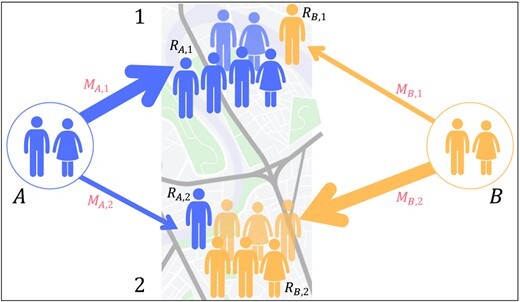
The diaspora model for human migration

Rafael Prieto-Curiel, Ola Ali, Elma Dervić, Fariba Karimi, Elisa Omodei, Rainer Stütz, Georg Heiler, Yurij Holovatch

PNAS Nexus, Volume 3, Issue 5, May 2024, page 178,

Migration’s impact spans various social dimensions, including demography, sustainability, politics, economy, and gender disparities. Yet, the decision-making process behind migrants choosing their destination remains elusive. Existing models primarily rely on population size and travel distance to explain the spatial patterns of migration flows, overlooking significant population heterogeneities. Paradoxically, migrants often travel long distances and to smaller destinations if their diaspora is present in those locations. To address this gap, we propose the diaspora model of migration, incorporating intensity (the number of people moving to a country), and assortativity (the destination within the country). Our model considers only the existing diaspora sizes in the destination country, influencing the probability of migrants selecting a specific residence. Despite its simplicity, our model accurately reproduces the observed stable flow and distribution of migration in Austria (postal code level) and US metropolitan areas, yielding precise estimates of migrant inflow at various geographic scales. Given the increase in international migrations, this study enlightens our understanding of migration flow heterogeneities, helping design more inclusive, integrated cities.

Read the full article at: academic.oup.com

Not your private tête-à-tête: leveraging the power of higher-order networks to study animal communication

Iacopo Iacopini, Jennifer R. Foote, Nina H. Fefferman, Elizabeth P. Derryberry and Matthew J. Silk

Phil Trans Roy Soc B

08 July 2024 Volume 379Issue 1905

Animal communication is frequently studied with conventional network representations that link pairs of individuals who interact, for example, through vocalization. However, acoustic signals often have multiple simultaneous receivers, or receivers integrate information from multiple signallers, meaning these interactions are not dyadic. Additionally, non-dyadic social structures often shape an individual’s behavioural response to vocal communication. Recently, major advances have been made in the study of these non-dyadic, higher-order networks (e.g. hypergraphs and simplicial complexes). Here, we show how these approaches can provide new insights into vocal communication through three case studies that illustrate how higher-order network models can: (i) alter predictions made about the outcome of vocally coordinated group departures; (ii) generate different patterns of song synchronization from models that only include dyadic interactions; and (iii) inform models of cultural evolution of vocal communication. Together, our examples highlight the potential power of higher-order networks to study animal vocal communication. We then build on our case studies to identify key challenges in applying higher-order network approaches in this context and outline important research questions that these techniques could help answer.

Read the full article at: royalsocietypublishing.org

Revealing the mechanism and function underlying pairwise temporal coupling in collective motion

Guy Amichay, Liang Li, Máté Nagy & Iain D. Couzin 

Nature Communications volume 15, Article number: 4356 (2024)

Coordinated motion in animal groups has predominantly been studied with a focus on spatial interactions, such as how individuals position and orient themselves relative to one another. Temporal aspects have, by contrast, received much less attention. Here, by studying pairwise interactions in juvenile zebrafish (Danio rerio)—including using immersive volumetric virtual reality (VR) with which we can directly test models of social interactions in situ—we reveal that there exists a rhythmic out-of-phase (i.e., an alternating) temporal coordination dynamic. We find that reciprocal (bi-directional) feedback is both necessary and sufficient to explain this emergent coupling. Beyond a mechanistic understanding, we find, both from VR experiments and analysis of freely swimming pairs, that temporal coordination considerably improves spatial responsiveness, such as to changes in the direction of motion of a partner. Our findings highlight the synergistic role of spatial and temporal coupling in facilitating effective communication between individuals on the move.

Read the full article at: www.nature.com

Infodynamics, Information Entropy and the Second Law of Thermodynamics

Klaus Jaffe

Information and Energy are related. The Second Law of Thermodynamics applies to changes in energy and heat, but it does not apply to information dynamics. Advances in Infodynamics have made it clear that Total Information contains Useful Information and Noise, both of which may be gained or lost in irreversible processes. Increases in Free Energy of open systems require more Useful Information, reducing or increasing Thermodynamic Entropy. Empirical data show that the more Free Energy is created, the more Useful Information is required; and the more Useful Information is produced the more Free Energy is spent. The Energy – Information relationship underlies all processes where novel structures, forms and systems emerge. Although science cannot predict the structure of information that will produce Free Energy, engineers have been successful in finding Useful Information that increases Free Energy. Here I explore the fate of information in irreversible processes and its relation with the Second Law of Thermodynamics.

Read the full article at: www.qeios.com