Category: Books

Multilayer Networks: Analysis and Visualization: Introduction to muxViz with R, by Manlio De Domenico

Provides practical recipes to use muxViz for specific purposes, bypassing theoretical obstacles
Includes dozens of examples whose R code is provided and directly linked from inside the text
Comes with, and builds on, a significant extension of the muxViz platform that can be used without needing a GUI

More at: link.springer.com

The Language Game How Improvisation Created Language and Changed the World

by Morten H. Christiansen and Nick Chater

Forget the language instinct—this is the story of how we make up language as we go

Language is perhaps humanity’s most astonishing capacity—and one that remains poorly understood. In The Language Game, cognitive scientists Morten H. Christiansen and Nick Chater show us where generations of scientists seeking the rules of language got it wrong. Language isn’t about hardwired grammars but about near-total freedom, something like a game of charades, with the only requirement being a desire to understand and be understood. From this new vantage point, Christiansen and Chater find compelling solutions to major mysteries like the origins of languages and how language learning is possible, and to long-running debates such as whether having two words for “blue” changes what we see. In the end, they show that the only real constraint on communication is our imagination.

More at: www.basicbooks.com

See Also: The Spontaneous Origins of Language

Higher-Order Systems

Edited by Federico BattistonGiovanni Petri

This book discusses its potential to model real-world systems and how considering their higher-order organization can lead to the emergence of novel dynamical behavior. Over the last decades, networks have emerged as the paradigmatic framework to model complex systems. Yet, as simple collections of nodes and links, they are intrinsically limited to pairwise interactions, limiting our ability to describe, understand, and predict complex phenomena which arise from higher-order interactions. Here we introduce the new modeling framework of higher-order systems, where hypergraphs and simplicial complexes are used to describe complex patterns of interactions among any number of agents. This book is intended both as a first introduction and an overview of the state of the art of this rapidly emerging field, serving as a reference for network scientists interested in better modeling the interconnected world we live in.

Read the full article at: link.springer.com

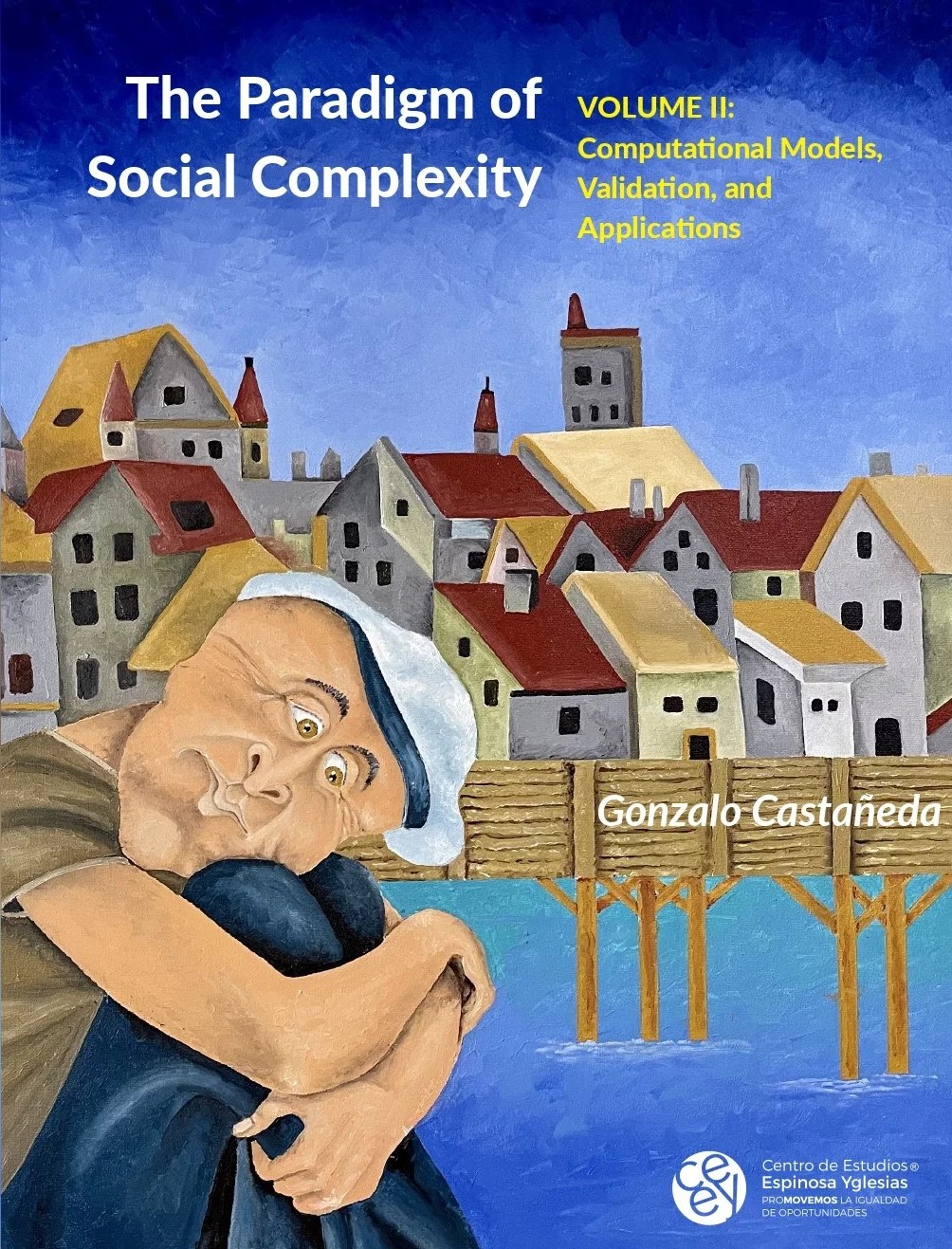
The Paradigm of Social Complexity

Volume I: An Alternative Way of Understanding Societies and their Economies
Volume II: Computational Models, Validation, and Applications

Gonzalo Castañeda

With the recent developments in computing technologies and the thriving research scene in Complexity Science, economists and other social scientists have become aware of a more flexible and promising alternative for modelling socioeconomic systems; one that, in contrast with neoclassical economics, advocates for the realism of the assumptions, the importance of context and culture, the heterogeneity of agents (individuals or organisations), and the bounded rationality of individuals who behave and learn in multifaceted ways in uncertain environments. The book synthesises an extensive body of work in the field of social complexity and constructs a unifying framework that allows developing concrete applications to important socioeconomic problems. This one-of-a-kind textbook provides a comprehensive panorama for advanced undergraduates and graduate students who want to become familiar with a wide range of issues related to social complexity. It is also a pioneering text that can support professors who wish to learn techniques and produce research in this novel field.

After reviewing the main concepts, premises and implications of complexity theory, the book frames this vision within the history of economic thought. Then, it articulates a meta-theory in which interdependent agents are embedded in a social context and whose collective and decentralised behaviour generates socio-economic phenomena. Such a framework builds on theories from evolutionary, institutional and behavioural economics, as well as analytical sociology. The book then reviews different computational tools for modelling complex adaptive systems, such as cellular automata, networks, and agent-based models. It elaborates on their analytical advantages in comparison to equation-based models, and how they can be calibrated/estimated and validated with empirical data. Finally, the book advocates for the practical use of these computational tools and makes a case for policy applications and the study of causal mechanisms.

More at: www.social-complexity.com