Month: October 2017

The Prize in Economic Sciences 2017

Richard H. Thaler has incorporated psychologically realistic assumptions into analyses of economic decision-making. By exploring the consequences of limited rationality, social preferences, and lack of self-control, he has shown how these human traits systematically affect individual decisions as well as market outcomes.

Limited rationality: Thaler developed the theory of mental accounting, explaining how people simplify financial decision-making by creating separate accounts in their minds, focusing on the narrow impact of each individual decision rather than its overall effect. He also showed how aversion to losses can explain why people value the same item more highly when they own it than when they don’t, a phenomenon called the endowment effect. Thaler was one of the founders of the field of behavioural finance, which studies how cognitive limitations influence financial markets.

Social preferences: Thaler’s theoretical and experimental research on fairness has been influential. He showed how consumers’ fairness concerns may stop firms from raising prices in periods of high demand, but not in times of rising costs. Thaler and his colleagues devised the dictator game, an experimental tool that has been used in numerous studies to measure attitudes to fairness in different groups of people around the world.

Lack of self-control: Thaler has also shed new light on the old observation that New Year’s resolutions can be hard to keep. He showed how to analyse self-control problems using a planner-doer model, which is similar to the frameworks psychologists and neuroscientists now use to describe the internal tension between long-term planning and short-term doing. Succumbing to shortterm temptation is an important reason why our plans to save for old age, or make healthier lifestyle choices, often fail. In his applied work, Thaler demonstrated how nudging – a term he coined – may help people exercise better self-control when saving for a pension, as well in other contexts.

In total, Richard Thaler’s contributions have built a bridge between the economic and psychological analyses of individual decision-making. His empirical findings and theoretical insights have been instrumental in creating the new and rapidly expanding field of behavioural economics, which has had a profound impact on many areas of economic research and policy.

Source: www.nobelprize.org

Where is technology taking the economy?

We are creating an intelligence that is external to humans and housed in the virtual economy. This is bringing us into a new economic era—a distributive one—where different rules apply.


Where is technology taking the economy?
By W. Brian Arthur

McKinsey Quaterly

Source: www.mckinsey.com

The shape of collaborations

The structure of scientific collaborations has been the object of intense study both for its importance for innovation and scientific advancement, and as a model system for social group coordination and formation thanks to the availability of authorship data. Over the last years, complex networks approach to this problem have yielded important insights and shaped our understanding of scientific communities. In this paper we propose to complement the picture provided by network tools with that coming from using simplicial descriptions of publications and the corresponding topological methods. We show that it is natural to extend the concept of triadic closure to simplicial complexes and show the presence of strong simplicial closure. Focusing on the differences between scientific fields, we find that, while categories are characterized by different collaboration size distributions, the distributions of how many collaborations to which an author is able to participate is conserved across fields pointing to underlying attentional and temporal constraints. We then show that homological cycles, that can intuitively be thought as hole in the network fabric, are an important part of the underlying community linking structure.


The shape of collaborations
Alice PataniaEmail authorView ORCID ID profile, Giovanni Petri and Francesco Vaccarino
EPJ Data Science20176:18
https://doi.org/10.1140/epjds/s13688-017-0114-8

Source: epjdatascience.springeropen.com

Data-driven modeling of collaboration networks: a cross-domain analysis

We analyze large-scale data sets about collaborations from two different domains: economics, specifically 22,000 R&D alliances between 14,500 firms, and science, specifically 300,000 co-authorship relations between 95,000 scientists. Considering the different domains of the data sets, we address two questions: (a) to what extent do the collaboration networks reconstructed from the data share common structural features, and (b) can their structure be reproduced by the same agent-based model. In our data-driven modeling approach we use aggregated network data to calibrate the probabilities at which agents establish collaborations with either newcomers or established agents. The model is then validated by its ability to reproduce network features not used for calibration, including distributions of degrees, path lengths, local clustering coefficients and sizes of disconnected components. Emphasis is put on comparing domains, but also sub-domains (economic sectors, scientific specializations). Interpreting the link probabilities as strategies for link formation, we find that in R&D collaborations newcomers prefer links with established agents, while in co-authorship relations newcomers prefer links with other newcomers. Our results shed new light on the long-standing question about the role of endogenous and exogenous factors (i.e., different information available to the initiator of a collaboration) in network formation.


Data-driven modeling of collaboration networks: a cross-domain analysis
Mario V Tomasello, Giacomo VaccarioEmail authorView ORCID ID profile and Frank Schweitzer
EPJ Data Science20176:22
https://doi.org/10.1140/epjds/s13688-017-0117-5

Source: epjdatascience.springeropen.com

Estimating local commuting patterns from geolocated Twitter data

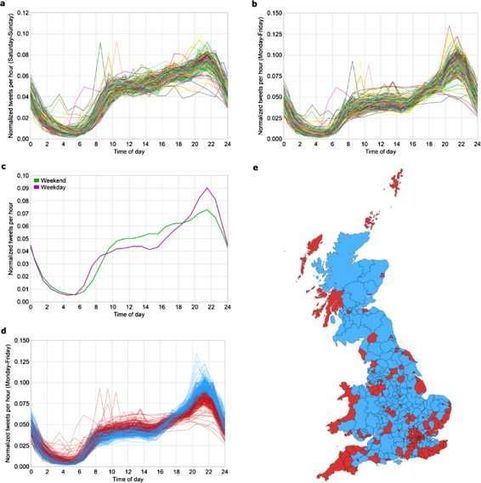
The emergence of large stores of transactional data generated by increasing use of digital devices presents a huge opportunity for policymakers to improve their knowledge of the local environment and thus make more informed and better decisions. A research frontier is hence emerging which involves exploring the type of measures that can be drawn from data stores such as mobile phone logs, Internet searches and contributions to social media platforms and the extent to which these measures are accurate reflections of the wider population. This paper contributes to this research frontier, by exploring the extent to which local commuting patterns can be estimated from data drawn from Twitter. It makes three contributions in particular. First, it shows that heuristics applied to geolocated Twitter data offer a good proxy for local commuting patterns; one which outperforms the current best method for estimating these patterns (the radiation model). This finding is of particular significance because we make use of relatively coarse geolocation data (at the city level) and use simple heuristics based on frequency counts. Second, it investigates sources of error in the proxy measure, showing that the model performs better on short trips with higher volumes of commuters; it also looks at demographic biases but finds that, surprisingly, measurements are not significantly affected by the fact that the demographic makeup of Twitter users differs significantly from the population as a whole. Finally, it looks at potential ways of going beyond simple frequency heuristics by incorporating temporal information into models.


Estimating local commuting patterns from geolocated Twitter data
Graham McNeill, Jonathan Bright, and Scott A Hale

EPJ Data Science 2017 6:24

https://doi.org/10.1140/epjds/s13688-017-0120-x

Source: epjdatascience.springeropen.com